Real Estate + Land Use Litigation

Real Estate + Land Use Litigation

Kegler Brown’s high-profile real estate practice receives regular honors from rating and review services in the legal industry. One such publication, Best Lawyers, consistently recognizes our firm’s capabilities in real estate disputes, particularly in the area of land use and zoning litigation.

A global publication, Chambers USA, has also honored our real estate practice as a whole, noting “The attorneys' strengths are intelligence, diligence, experience in a wide range of real estate ownership and financing issues, and a sense of urgency in resolving matters quickly.”

Few lawyers represent their clients in all aspects of real property, land use, zoning, and development like the attorneys at Kegler Brown. We represent clients from commencement before the local government throughout the entire litigation process. Our comprehensive team understands the diverse needs of our clients and the specific areas of the law associated with development, including zoning, environmental, transactional, tax, and contract matters.

To provide continuity on matters relating to the acquisition, transfer, development and use of land, we represent private property owners, developers and local governments in all courts; we also litigate issues involving development, tax incentives and real property taxes. Our representation includes such issues as annexation and administrative zoning decisions (e.g., permits; conditional use; variance; development plan approval; and the subdivision and platting of land). We represent both public and private owners in eminent domain cases and have represented clients before the Board of Revision, the Board of Tax Appeals and throughout courts in Ohio on real property tax matters.

Our Services

  • General litigation
  • Legislative actions
  • Administrative proceedings
  • Quasi-judicial proceedings
  • Appeal of administrative determinations
  • Original actions
  • Eminent domain and condemnation proceedings
  • Representation before Board of Revision / Board of Tax Appeals

Our Clients

We serve private property owners, developers, local governments and political subdivisions in administrative, quasi-judicial, and judicial proceedings in all courts and on all matters related to development. We also represent local governments in matters involving annexation, zoning, and land use.



Experience

Foreclosure + Receivership for Downtown Mixed-Use Property

Two Receiverships for Affordable Housing Properties

Chapter 13 Objection + Asset Recovery for Community Bank

Lease Dispute with Prominent Central Ohio Restaurant

Lease Dispute with Prominent Central Ohio Restaurant

Multi-Claim Litigation Dispute with Property Owner Payment

Contractors shaking hands

Neighbor-to-Neighbor Property Easement Dispute

A suburban residential overhead streetview

Defending Columbus Metropolitan Housing Authority and Assisted Housing Services Corporation in Breach of Contract Claim

Ohio Supreme Court Appeal of Landowner Rental Payments

A telecommunications pole with imagery of connected dots overtop

Publications + Presentations

publication

Ohio’s Revised LLC Act - What You Need to Know

publication

5 Recommendations for Universities Facing Tuition Refund Class Action Suits

Smart Summary If your college or university sees a class action suit as a result of COVID-19, contract terms, including language of any force majeure clauses, will be critical.In addition to contract-based defenses, colleges + universities may look to procedural defenses and common law defenses like “impossibility” and “frustration of purpose.”Universities will want to think through their refund and future service credit offerings to try to minimize claims and any potential damages. In the wake of colleges and universities across the country turning to distance learning to minimize the spread of COVID-19, it is no surprise that putative class action complaints are now being filed seeking refunds and discounts on tuition and other fees paid by students. By now, you likely already know that cases have been filed against Purdue University, the University of Miami, Drexel University, and the Boards of Regents of both the University of Colorado and the University of Arizona. A number of these suits have been brought by the same law firm, which is attempting to attract new cases through its website “CollegeRefund2020.com.”Some of the suits seek reimbursement of a portion of paid tuition, based on the theory that the students contracted for an on-campus educational experience, which has not been provided. Other suits seek reimbursement of a portion of paid housing, meal plan expenses, and/or other service fees relating to athletic facilities, medical services or other amenities.For in-house counsel at universities across the country who are pondering whether their institution will be the next target of these lawsuits, we’ve outlined five key questions you should be considering if (and even before) your institution is sued.What are the contract terms? The claims being filed are predominantly contract claims, so the specific language of your institution’s contractual relationships with its students will be important. The applicable terms may specifically address refunds, school closures, and emergency circumstances. Is “force majeure” a defense? You and your outside counsel should consider whether there are any contractual force majeure provisions that may relieve performance in the event of some unforeseeable circumstance like a nationwide pandemic. Again, the specific language of your force majeure provision is important.Are there common law defenses? Even if the contractual language at issue does not contain a force majeure provision, certain common law defenses may be available, depending upon the jurisdiction in which any suit is brought and the applicable law. Common law principles of “impossibility” and “frustration of purpose” can, under some circumstances, provide a defense.Are there procedural defenses? In addition to contract-based defenses, procedural defenses may also be available to you. An institution that has been sued will want to consider: whether personal jurisdiction exists in the jurisdiction in which the suit has been brought; whether the named plaintiff is an appropriate representative of the putative class; how the class or classes have been defined; and whether the traditional legal requirements for each claim have been met. Unjust enrichment claims are included in several of the early cases. The law of most states holds that claims for breach of contract and unjust enrichment are mutually exclusive, although many states allow plaintiffs to plead both, subject to later proof and/or choice of remedy.What can be done to minimize claims and potential damages? The relevant facts vary from university to university. Some universities have allowed students to remain in student housing and to continue to receive meals pursuant to their meal plan, while other universities have ceased housing and cafeteria operations entirely. Some universities have offered refunds or partial refunds, while others have not. Ensuring students stay on track to receive course credits toward graduation during periods of necessary distance learning will help to mitigate potential damages. Institutions that think creatively and take steps to introduce new ways of fostering community engagement and mentorship that would otherwise take place in residence halls will also be in a better position to defend tuition claims. For example, if a student took History 101 during the mandated period of distance learning, allowing him or her the option to re-take the class in-person once school resumes may be a productive way to mitigate potential damages. Similar options may exist for meal, athletic and health services. However, similar options may not exist with respect to housing availability. While closure decisions may already have been made, universities will want to think through their refund and future service credit offerings to try to minimize claims and any potential damages.No matter the course of action you choose, college and university counsel should be in close communication with their outside counsel partners, in particular those with substantial class action experience. Discussing these and other potential defense strategies can give your institution a head start on any litigation that may be headed your way.Vinita Mehra is a director and chair of Kegler Brown’s Global Education practice group, and works with college and university clients across the country on their operational and strategic planning issues. She can be reached directly at vmehra@keglerbrown.com or (614) 255-5518.Lori Fuhrer and Robert Cohen are directors and experienced trial lawyers in Kegler Brown’s Class + Collective Action practice, where they defend clients in contract and class action litigation of all kinds.Fuhrer can be reached directly at lfuhrer@keglerbrown.com or (614) 462-5474.Cohen can be reached directly at rcohen@keglerbrown.com or (614) 462-5492. 

publication

Are Ohio’s Commercial Landlords and Lenders Now Required to Give a 90-day Reprieve?

Smart Summary Governor DeWine issued an executive order requesting landlords to suspend commercial rent payments for at least 90 days. The Order also urges lenders to offer a similar reprieve to their landlord borrowers. The Order is not legally binding, though more forceful language could potentially be forthcoming. Since the COVID-19 crisis began, we’ve been fielding calls and e-mails from clients on both sides of the commercial landlord-tenant relationship.  Tenants negatively affected by the crisis want some sort of relief from their landlords in terms of a rent abatement or forbearance, and landlords are receiving a crippling volume of these requests from their tenants. Typically, there is no legal ground to require a landlord to grant an abatement or deferral request, but from a practical standpoint, it still may make sense for them to work with commercial tenants if the alternative is for those tenants to permanently close their doors. At the same time, it’s also important to recognize that landlords may be caught between a rock and hard place. Most are still required to make mortgage payments and pay taxes, common area maintenance costs and other expenses, without receiving rent from their commercial tenants. Each side may also put the responsibility on the other to attempt to obtain relief from federal sources, including the SBA’s Economic Injury Disaster Loan program and the Paycheck Protection Program provision of the recently passed CARES Act. To date, however, there hasn’t been an across-the-board standard or a one-size-fits-all approach for negotiations between commercial landlords and tenants dealing with the effects of COVID-19.Governor DeWine Opines with an Executive Order In an attempt to provide some relief for both sides, Governor Mike DeWine issued Executive Order 2020-08D on April 1, urging Ohio landlords to suspend rent payments and evictions for at least 90 days for small-business tenants experiencing “financial hardship due to the COVID-19 pandemic.” Accordingly, to assist those landlords who would then be at risk of defaulting on their own mortgages, the Order also requests that lenders agree to a minimum 90-day forbearance and refrain from enforcing default penalties or initiating foreclosures during that period. The Order specifies, however, that the governor is not requesting a rent abatement under the leases, nor forgiveness of mortgage payments, just a delay in collections instead.Interpretation: Request or Requirement? While the language may not be entirely clear, our interpretation of this Order is that it is a request, not a requirement , and that landlords and lenders alike are not currently legally obligated to comply. However, we think it’s unlikely that a court in Ohio is going to take up a foreclosure action at this time. Given the rapidly evolving pace of change right now, it’s certainly possible for Governor DeWine to sign a more forceful Order before this situation is over. Regardless, this Order may provide a new baseline for negotiations between landlords and tenants as they navigate through the COVID-19 crisis. Michael Schottenstein is an associate attorney in Kegler Brown’s Real Estate + Finance practice. He represents both commercial landlords and tenants in the drafting and negotiation of leases, amendments and works with clients in the context of their more general business operations. Michael can be reached at mschottenstein@keglerbrown.com or (614) 462-5451.

publication

Annexations in Ohio

Ohio Municipal Attorneys Association 2019 Winter Municipal Civil Law Seminar
publication

Winning at Trial

On November 20, Tom spoke during a one-day trial advocacy seminar featuring several of Ohio’s leading trial lawyers. Attendees were taken through the trial process, gaining insight on tactics and strategies leading up to and during trial. Topics discussed also included approaches to pre-trial discovery, preparing for trial, jury selection, opening statements, direct and cross examinations, and closing arguments. Tom spoke on cross examinations, giving step-by-step guidance on preparing questions and emphasizing the importance of organization. 

OSBA webinar cosponsored by the ACTL
publication

The Art of Witness Preparation

On August 9, 2019, Tom presented to the Legal Aid Society of Columbus on the oft-overlooked topic of teaching witnesses to be witnesses. While most educational programming for lawyers focuses on what they must do in a courtroom, little guidance is provided for preparing witnesses, who are speaking in an alien environment and are often frightened and uncertain. Focusing on a witness’s role in persuading a jury, Tom described to attendees how to work with a witness to tell a story using organized, open-ended questions that allow the witness to comfortably tell their portion of the truth. He discussed preparing for direct and cross-examination, as well as the importance of not over-preparing. 

Legal Aid Society of Columbus
Article

Real Estate Considerations in the Medical Marijuana Arena

When an entity or individual associated with medical marijuana is interested in purchasing or leasing real estate for their business, there are additional considerations that should be added to checklists and analyzed throughout the due diligence process in order to comply with the Ohio Medical Marijuana Control Program (“MMCP”) regulations.#1 Location Restrictions:Although the processing/testing/dispensing rules are not yet final, they are leaning to be in line with the cultivation license rules. ORC 3796.30 prohibits any medical marijuana cultivator, processor, or retail dispensary from being located within 500 ft. of the boundaries of any parcel of real estate located near a school, church, public library, public playground or public park. This does not mean 500 ft. from door to door, but parcel boundary to parcel boundary. Dispensary rules will likely include an additional limitation prohibiting dispensaries from being located within 500 ft. of a community addiction services provider.#2 Zoning Considerations:House Bill 523 authorizes the legislative authority of a municipal locality or township board to adopt their own regulations to prohibit or limit the number of medical marijuana facilities within their locality. Often times, a locality will limit cultivators and processors, but not dispensaries, or some other combination of the three. It is critical to check the local zoning rules of a proposed medical marijuana facility because the MMCP will require every applicant to provide evidence of compliance with all local ordinances, rules or regulations adopted by its locality.#3 Evidence of Compliance:If the processing and dispensing applications follow the cultivation license application, it is likely that the MMCP will require (or at least encourage) applicants to get a notarized signature from an individual representing the proposed facility’s locality. This is intended to show that the applicant is in compliance with the local zoning regulations, but can be tricky in localities that have been silent on the matter or are not yet prepared to authorize such a statement.#4 Leases & Unclosed Purchases:The owner of the real estate will likely need to sign off that there are no use restrictions on the property, or any lease restrictions in a leasehold, that would otherwise prevent the applicant from complying with MMCP regulations. If the applicant does not own the property, the applicant will most likely need to get their landlord and/or the owner of the property to sign and notarize a form in the application affirming that no such restrictions exist. This can be tricky when the owner/landlord is an unrelated third party and is unclear on their position or intentions for the property in relation to the medical marijuana industry. Strategy and open communication should be utilized to avoid a situation where the deal is being held up due to a lack of signature.The next few months will see many more questions and answers as Ohio rolls out final rules for medical marijuana processors and dispensaries. If you have questions concerning the Ohio Medical Marijuana Control Program, its regulations or application process, contact me at rgold@keglerbrown.com.

publication

Special Improvement District

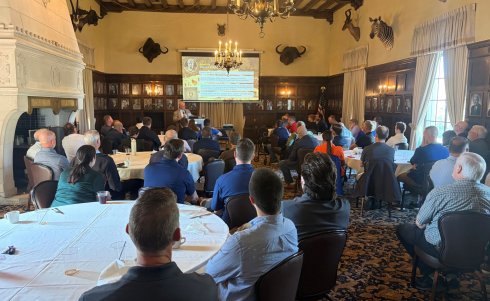
On November 19, 2015, the Capital Crossroads Special Improvement District met with Midge McCauley and local real estate developers, brokers, attorneys and business owners for a round table discussion on how to revitalize downtown Columbus.McCauley, a national retail expert, recommended a plan of action where property owners and landlords work together with potential tenants in creative ways to help bring a diverse and rich mix to our downtown. Attendees voiced their concerns and each had a common theme; downtown Columbus needs to improve its local traffic beyond workweek hours, vary its restaurant and retail selection and focus on becoming an area where local business owners have an opportunity to invest in the growth of downtown. McCauley referenced the successful programs that were implemented in Nashville and Austin, where initial efforts by brokers and landlords extended to more than 600 potential tenants, resulting in 100-200 responses, followed by dozens of on-site visits. Ultimately, a variety of tenants moved in, ready and willing to be at the forefront of downtown revitalization. Each of these cities started in a similar position as us here in Columbus and have eventually grown to be bustling downtowns. Although this method may not be the exact plan we need to implement in order to generate interest and spark the growth of downtown Columbus, the luncheon was a successful starting point in gathering various local professionals together to discuss our own plan of action to revitalize downtown Columbus. 

Kegler Brown Real Estate News

Firm Highlights